Team Development Frameworks and Practice

Teams are the core unit of productivity, innovation and transformation in an organization...
Consider, that your organizational system is perfectly designed to deliver the results it is delivering now...
Transforming teams (teams of teams) into high performance cohesive units is the building block for the organization to live its purpose...
Challenges for CEO's and Team Leaders
As a CEO or team leader, you are constantly navigating complex and complicated realities. You know intuitively that teams are the core units of transformation, work, and productivity. Yet, if we are being deeply honest, how often do you look at your group and simply wish they were performing better together? You see the raw talent sitting around the table, but you find yourself wishing for higher outputs, smoother execution, and greater overall effectiveness.
As a former CEO, I understand the weight of that frustration. The truth is, bringing brilliant individuals together doesn't automatically create a brilliant team. Too often, the friction of team interaction results in process losses rather than process gains. My role is to help you rewire that dynamic—aligning your team's purpose and structure so that the collective output is finally greater than the sum of its parts."
1. The Philosophy: What is a Team?

A team is not just a group of people working near each other. A team is an emergent organizing system of interdependent individuals driven by common purpose and vision, bounded by mutual accountability and passion.
- Emergent: The process where a group transcends individual roles to become a living, evolving entity.
- Interdependence: The invisible web of reliance where players are connected through shared actions and needs.
- Common Purpose & Accountability: The North Star that shifts focus from individual agendas to a singular mission, backed by the shared commitment to collective results.
- Passion- this is the energy that unlocks engagement and creativity.
2. The Architecture: The 4 Quadrants of Team Effectiveness

- Team Purpose & Blueprint (The Fire): The driving force and energy for the work. I focus on core meaning and team attunement to its purpose, aligning this with your organizational goals.
- Team Collective Intelligence (The Air): Cultivating the team wisdom. I assist in creating the conditions for continuous learning, strategic decision-making, and fluid, frictionless communication.
- Team Dynamics & Cohesion (The Water): Building psychological safety. I help you to transform conflict into an asset, transmute unrecognized trauma, and build a genuinely healthy culture.
- Team Structure & Goals (The Earth): The structural elements. I assist you in creating the team container ( team playbook) through optimizing operating norms, setting ground rules, meeting rhythms, and time commitments for maximum efficiency.
3. The Engine: The Transformation Loop
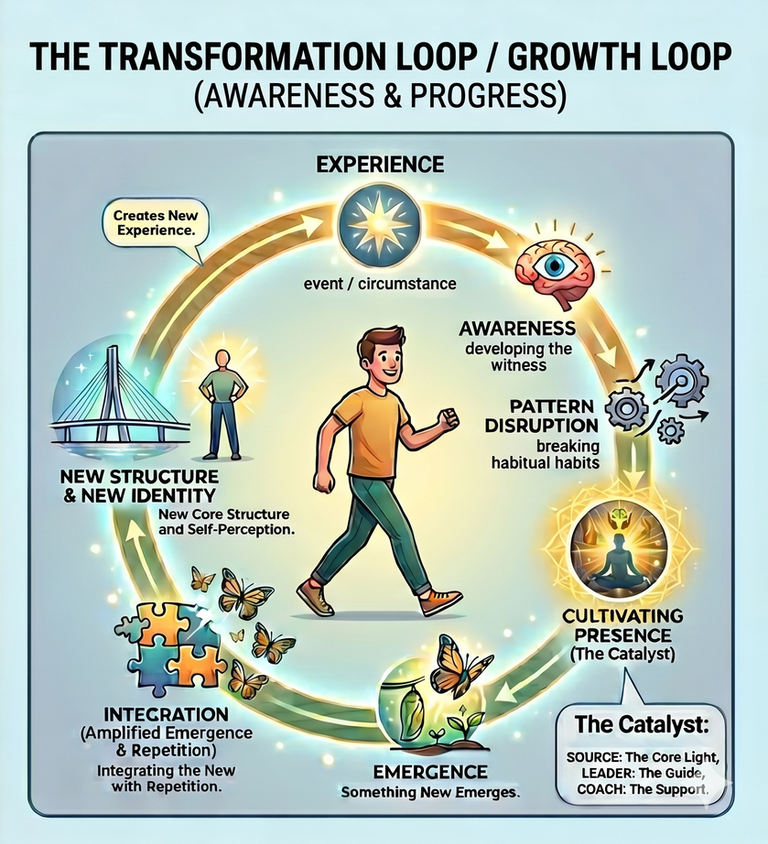
This process is the inner process that results in individual, team transformation
- Experience: The current collective reality of the team and what it is experiencing or has created.
- Awareness: Collective sensing and developing objectivity in the team to identify the deeper causations and patterns of the team's current operational reality.
- Pattern Disruption: Naming the current habit or patten and choosing a different reaction that breaks state.
- Cultivating Presence (The Catalyst): Aligning with the team’s Core purpose and "why" to build the momentum for the required shift.
- Emergence: The Aha moment where innovative solutions and new ways of collaborating arise.
- Integration: Institutionalizing growth through new rituals, feedback loops, and engagement rules.
- New Structure & Identity: The team structure has changed to a new level of awareness, operational model and new capabilities.
4. The Process of Team Coaching
The optimal process of team development is for the team to set aside specific time to work on team dynamics and then also integrate team coaching into real time work structures such as meetings, strategic planning sessions etc.

- The Deterministic Approach: Identifying structural blind spots, utilizing diagnostic metrics, and building developmental roadmaps.
- The Emergent Approach: Real-time, in-the-moment interventions to uncover and disrupt unconscious patterns exactly when they happen.